


Toolkit: Serving Our Neighbors Safely
This toolkit provides practical guidance, trusted resources, and training to help faith communities and community organizations respond to Arizona's housing crisis with compassion, healthy boundaries, and safety.
Explore best practices, local and national resources, and expert-led webinar recordings to help your organization create safe, welcoming spaces for all.
-
Every Organization Can Make a Difference
Faith communities and community organizations increasingly encounter people experiencing homelessness, housing instability, poverty, behavioral health challenges, or financial hardship. While most organizations are not housing providers or emergency shelters, they can play an important role by creating welcoming environments, responding safely, and connecting people with appropriate resources.
Your role is not to solve every problem
Your role is to:
Welcome people with dignity and respect.
Maintain a safe environment for everyone.
Know your organization's boundaries.
Build relationships and get to know those you serve.
Connect people with trusted community resources.
Build partnerships with local service providers.
Safety First
Every interaction should consider the safety of:
Visitors and guests
Staff and volunteers
Congregants and program participants
The individual seeking assistance
-
Someone asks for money
Listen respectfully.
Explain your organization's policies.
Offer information about local resources when available.
Avoid making promises you cannot keep.
Someone asks to stay overnight
Explain whether overnight accommodations are available.
Provide referrals to shelters or outreach providers if appropriate.
Know local after-hours resources.
Someone wants to remain in the building after closing
Communicate closing times early.
Offer available resource information.
If someone refuses to leave and safety becomes a concern, follow your organization's procedures and contact law enforcement only when necessary.
Someone appears to be experiencing a behavioral health crisis
Speak calmly.
Give the person space.
Avoid arguing or making sudden movements.
Contact a mobile crisis team or call 911 if there is an immediate safety risk.
Someone appears to have a medical emergency
Call 911.
Provide first aid only if trained.
Stay with the individual until help arrives if it is safe to do so.
-
Questions Every Organization Should Ask
Do we know how we will respond when someone asks for help?
Are staff and volunteers trained in respectful communication and de-escalation?
Do we have current referral information for local resources?
Are our policies clear and consistently applied?
Do we know when to call emergency services?
Have we built relationships with local outreach providers and housing organizations?
Do we review incidents and update our practices?
Guiding Principles
Treat every person with dignity and respect.
Maintain healthy boundaries.
Prioritize the safety of everyone on site.
Recognize that no single organization can meet every need.
Work collaboratively with community partners.
Continue learning as community needs evolve.
-
AFN Heat Guidebook (Policies and guidebook on running programs with vulnerable populations)
AFN Heat Relief Staff and Volunteer Training Video (Deescalation training, safe space training, and naloxone training)
Compassionate No Sleeping on Property Sign (Please make a copy of your own in Canva before editing)
-
Law enforcement is an important community partner, but not every situation requires a police response. When there is no immediate threat to life or safety, consider connecting with community resources first.
Best Practices
Call 911 immediately if there is an immediate threat to life, serious injury, violence, or a crime in progress.
Call 211 to connect individuals with housing, food, behavioral health, and other social services.
Call 311 (where available) to request city services or non-emergency assistance, including outreach for individuals experiencing homelessness.
Build relationships before you need them. Introduce yourself to your local police department's Community Resource Officer (or Community Action Officer) and explain your organization's mission, values, and approach to serving people with dignity and compassion.
Discuss expectations in advance. Share your organization's policies, preferred communication methods, and when you would like law enforcement involved. Understanding each other's roles before a crisis helps build trust and leads to better outcomes.
Know your local outreach partners. Develop relationships with homeless outreach teams, behavioral health providers, fire departments, and crisis response organizations so you have multiple options when someone needs assistance.
Remember: The goal is to connect people with the most appropriate resource while maintaining the safety of staff, volunteers, guests, and the broader community. When strong relationships exist between community organizations, outreach providers, and law enforcement, responses are often more effective, coordinated, and compassionate.
-
Occasionally, an individual may engage in behavior that threatens the safety of others or repeatedly violates your organization's policies. Restricting access to your property should be a last resort after reasonable efforts to resolve the situation have been unsuccessful, unless there is an immediate safety concern.
Before Restricting Access
When it is safe to do so:
Remain calm and respectful.
Clearly explain the behavior that is creating concern.
Remind the individual of your organization's expectations.
Offer an opportunity to correct the behavior, if appropriate.
Document the incident.
Consider Restricting Access If:
Violence or threats of violence occur.
Weapons are displayed or used.
Property is intentionally damaged.
Illegal activity occurs.
The individual repeatedly violates organizational policies despite previous warnings.
Staff, volunteers, or other guests cannot be kept safe.
If You Need Someone to Leave
Have two staff members or volunteers present whenever possible.
Speak calmly and respectfully.
State the expectation clearly:
"We are asking you to leave the property today because your behavior is not consistent with our safety policies."
Avoid arguing or escalating the situation.
If the individual leaves voluntarily, document the incident.
If the Individual Refuses to Leave
If someone refuses to leave private property after being asked, they may be trespassing under applicable law. If there is no immediate danger, follow your organization's procedures and contact your local non-emergency law enforcement line for assistance. If there is an immediate threat to safety, call 911.
Documentation
After the incident:
Record the date, time, and location.
Document the observed behavior (not assumptions or opinions).
List staff or witnesses present.
Note any actions taken and referrals offered.
Record whether law enforcement or other agencies were contacted.
Best Practices
Develop a written trespass or restricted-access policy before an incident occurs.
Apply policies consistently and without discrimination.
When appropriate, provide information about alternative community resources.
Review significant incidents with staff afterward to identify lessons learned and update procedures if needed.
Remember: Restricting access is intended to protect the safety of everyone while treating every person with dignity and respect. Consistent policies, clear communication, and thorough documentation help ensure fair and appropriate decision-making.
Resources and Trainings
-
Arizona Resources
Phoenix & Maricopa County
Tucson & Pima County
-
National Resources
-
Safety & Training Resources
Serving Our Neighbors Safely Webinar Recordings
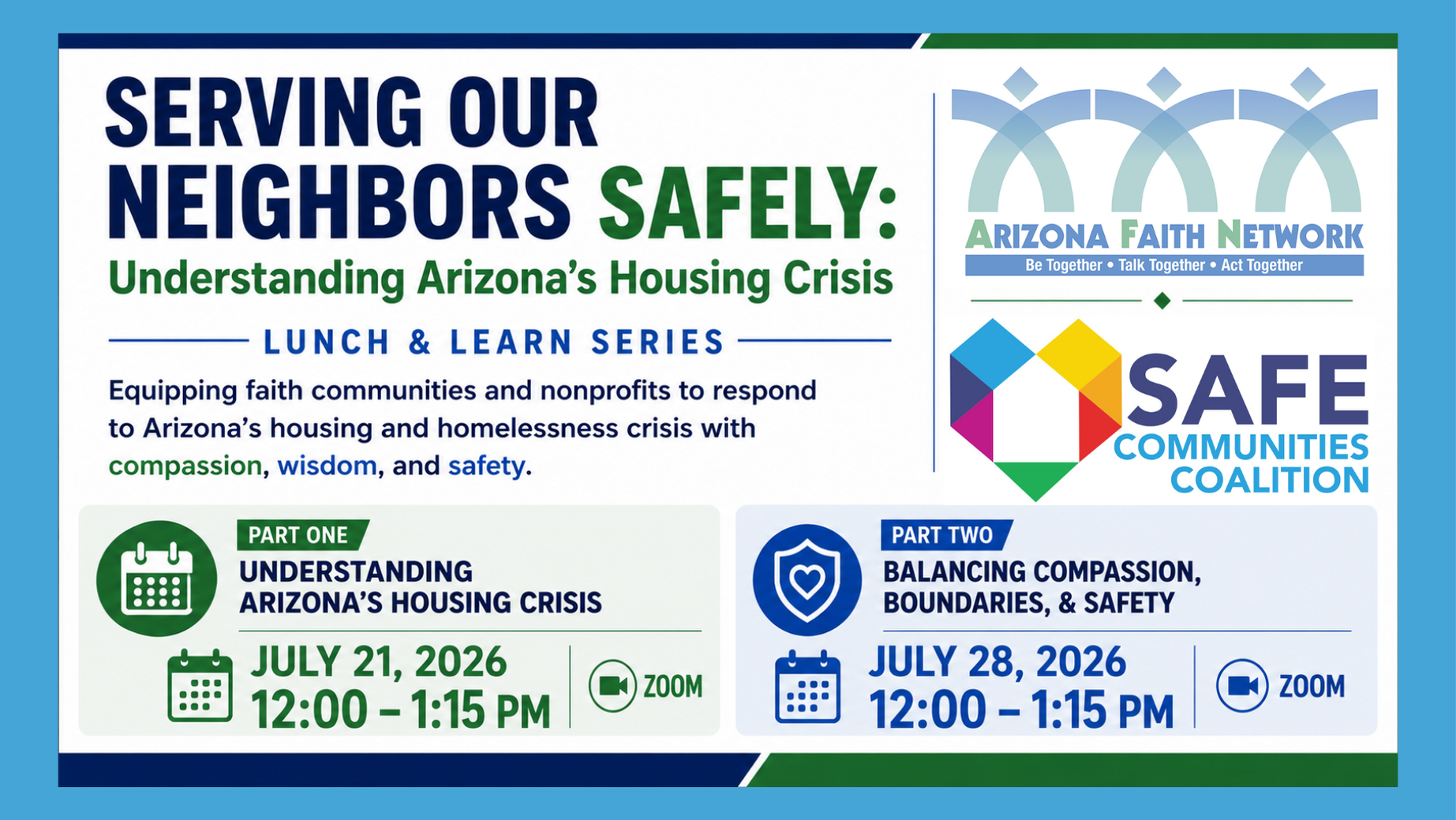
Serving Our Neighbors Safely: Understanding Arizona's Housing Crisis – Part 1
Arizona Faith Network and the Safe Communities Coalition explore Arizona's housing crisis and the role faith communities and nonprofits can play in responding with compassion, safety, and dignity.
Featured Speakers: Austin Bates, Arizona Housing Coalition, Rev. Susan Valiquette, First Church UCC, Dean Scheinert, Justa Center, Betty Bitgood, Hope of Glory Ministries
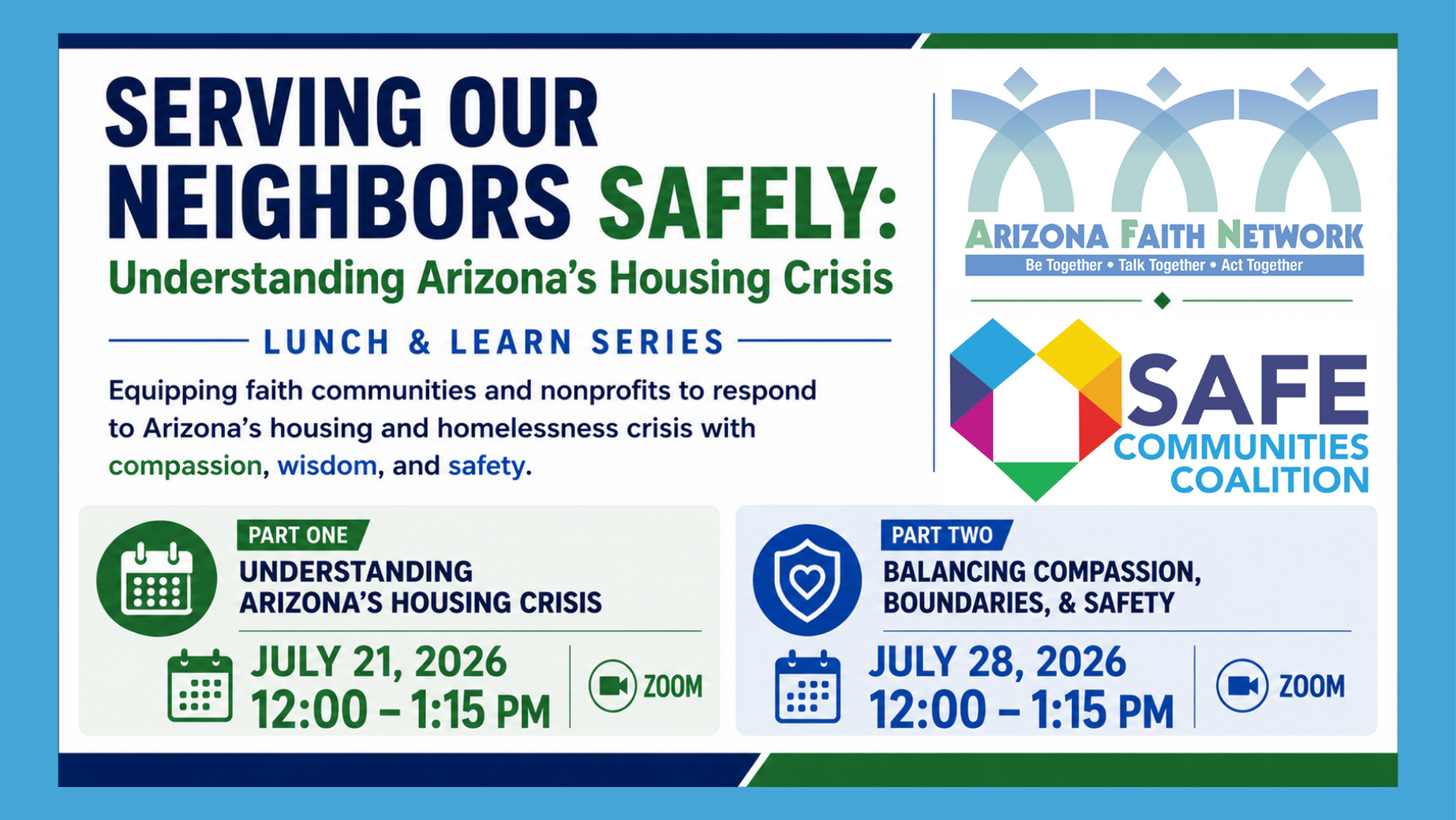
Serving Our Neighbors Safely: Practical Strategies for Responding to Arizona's Housing Crisis – Part 2
In the second session community leaders share practical tools and real-world strategies to help faith communities and nonprofits respond to the housing crisis with compassion, healthy boundaries, and safety.
Featured Speakers: Scott Hall, City of Phoenix Office of Homeless Solutions, Thelma Magallanes, Community Services Project Supervisor, Housing & Community Development, City of Tucson, and Arene Rushdan, Arizona Faith Network.